Many people experience what is often referred to as an “earworm”. That is when you get a bit of a song stuck in your head and you can’t quite get rid of it. Often your only recourse is to either listen to the piece of music itself in a form of fighting fire with fire, or hope it gets replaced with some other thing that is less exasperating while it loops around your aural canal like a rhythmical rollercoaster.
I find I get this problem, not just with music, but also with scenes from TV shows or movies. If music creates “earworms”, I think these are potentially “cinematic caterpillars” or “motion picture eels” that wiggle their way through my subconscious.
And me being me, they are often slightly obscure pieces of sci-fi or daft comedy that will decide to implant themselves on a random day and keep me distracted from my tasks at hand until I relive the pressure. That will, like with the music, either involve me watching said film or TV programme, or hoping that the alternative obscure bit of sci-fi and/or comedy I am engaged with, forces the caterpillar into its chrysalis and that out of this will emerge the fully formed butterfly of relief!
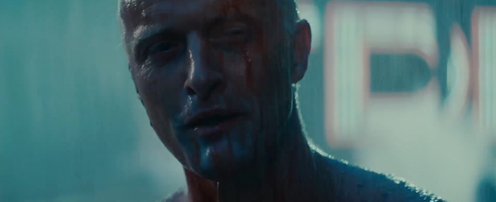
Recently, the scene that has been rattling round my cranium has been sci-fi, although not that obscure. It has been nominated in many places as one of the top ten greatest movie scenes and soliloquies of all time. That being the late Rutger Hauer’s “Tears in rain” speech from the end of Ridley Scott’s masterpiece Blade Runner.
It is a brief monologue that his character, Roy Batty, delivers as his last words to the man that has been hunting him, Blade Runner Rick Deckard, played by the inimitable Harrison Ford.
If you are unfamiliar with the scene, I invite you to enjoy it now, (it’s less than 3 minutes long), and then I further invite you to read on to see why it got stuck in my head:
Blade Runner is based upon the novel, Do Androids Dream of Electric Sheep by Philip K. Dick, an excellent read, as is the book Dune by Frank Herbert. This weekend I had the pleasure of enjoying the most recent part of the Dune saga in the cinema with some dear friends. (Again, an experience I recommend on both counts). Dune and Dune: Part Two are directed by probably my favourite modern director, Denis Villeneuve – A man who truly understands the principle of “cinematic” in my opinion. Villeneuve also turned his hand to directing the sequel to Blade Runner – Blade Runner 2049 and thus I think in my excitement to see one movie, my brain got itself all in a tizz and merged these things together and thus began my “cinematic caterpillar”. (™ !)
However, the Tears in Rain scene cannot be dismissed as a mere background buzz on an otherwise average day. It has been discussed and analysed as one of the most moving death scenes ever in cinema or even beyond, due to how it signifies a moment of clarity at the point of the end of a life.
Hence, as I have wandered around these past few weeks, enjoying time with friends and family, jumping like a mad man celebrating goals at the football, laughing till my cheeks hurt at excellent comedy, and being overwhelmed by landscapes of breathtaking beauty and starkness, and even a murmuration of starlings, this scene has come into my mind over and over again:
“I’ve seen things you people wouldn’t believe… Attack ships on fire off the shoulder of Orion… I watched C-beams glitter in the dark near the Tannhäuser Gate. All those moments will be lost in time, like tears in rain… Time to die.”
Now, don’t worry I am not planning on going anywhere soon, but it does make you think about all your experiences in life. In addition, despite the public record that social media provides, there are many memories that I have that will never be seen or understood by others for their profound effect on my life and how I view the world. One day, they will be lost like tears in rain.
This has got me thinking about whether that is as melancholy as it seems at initial reading/watching. One interpretation of the scene from Blade Runner is that it represents a moment of pure lucidity and a realisation of how precious our own experience is. In addition, it reminds us of how those experiences drive our memory and the story of us as individuals.
Hence, I have been thinking about what my things that I have seen are, and are therefore the cornerstones of my story. Three memories that come to mind are, “swimming in a warm Hawaiian wave with my wife and watching a turtle surf to shore”, “gazing at Saturn’s rings through my telescope on a clear and frosty night” and “the smell of indoor fireworks during a family Christmas in the lounge of my late grandparent’s home”.
And yet the most comforting thing is that I realise my list is too long to write down. It could continue for reams and reams and that in of itself is amazing when I consider it. If I could hold that emotion in my mind every day, there would be no greater salve to the trials and tribulations of the world. It is something I shall endeavour to do more of. It doesn’t matter that one day they won’t be remembered. It’s more important that they happened, and I recognise how very fortunate I am to have experienced them. That I can believe in.
P.S. I have also discovered that writing a blog is a way of dealing with a “cinematic caterpillar ™” – so that’s a useful memory too!

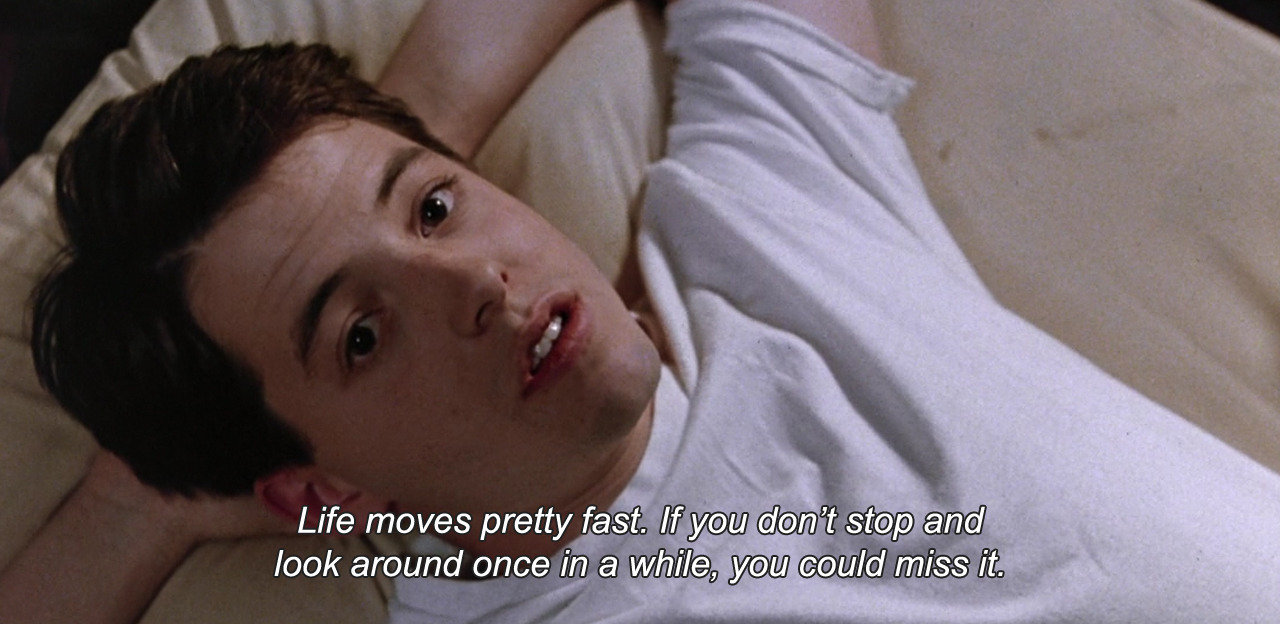
 Life moves pretty fast
Leave a comment