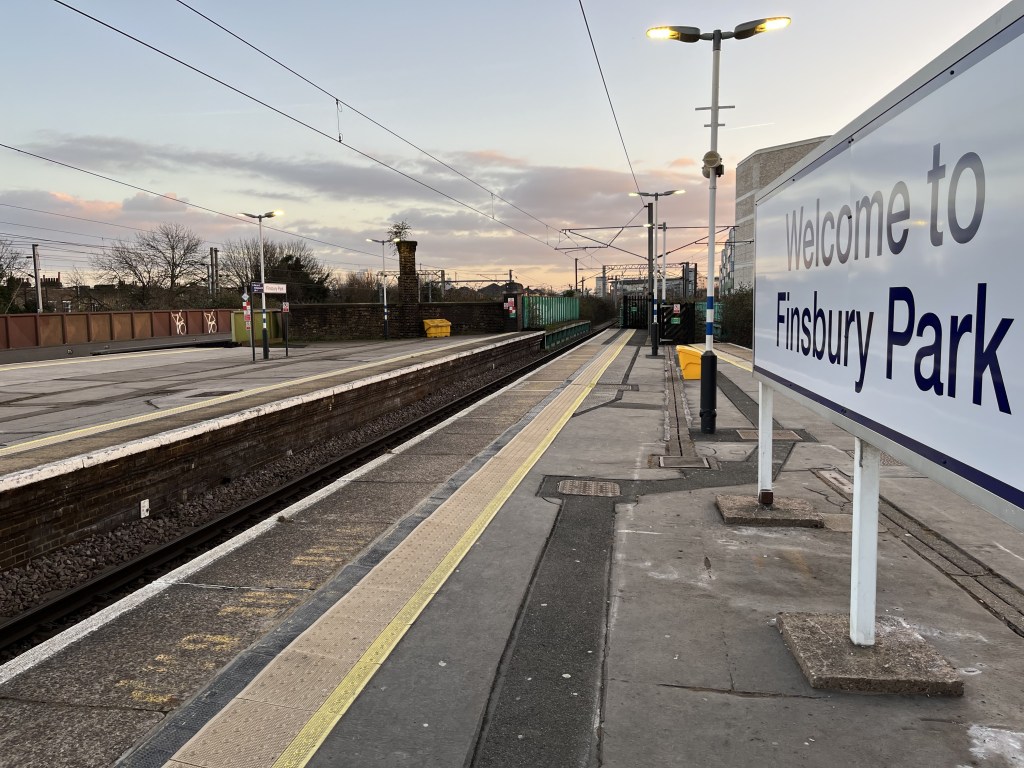
I have found myself becoming increasingly familiar with a very specific if rather, on the surface at least, unremarkable location in North London. It is a piece of grey tarmac about twenty yards from the southern end of platform seven of Finsbury Park station. It has become a place of contemplation for me but is also related to a certain amount of geekiness and/or smartness on my part. More of that in a bit. However, I was recently encouraged in a creative writing course to consider the specifics of a location to truly understand what it represents and maybe turn the unremarkable into the remarkable. Thus, I thought this might be a good spot to try this out.
In front of where I stand, there is a yellow line running parallel to the tracks designed to keep travellers away from the edge of the platform. This is either to prevent them being clipped by an incoming train or to avoid a buffeting by the air generated a passing unit heading north. This yellow line is part of a strip of bobbled tactile paving designed to provide the same warning for those with limited vision. When the platform, and the adjacent platform 8 is incredibly busy with travellers, the announcements from the Finsbury Park platform staff to remind people to stand behind this line can only be described as incessant!
Interestingly as a side note, I was at Doncaster station recently and one of the announcements there specifically mentioned how platform 3 is missing this haptic paving. There is a long way to go, but I do think it is excellent that we have reached a point as a nation where the lack of this simple disability support infrastructure is worthy of announcement.
There is then a line of concrete slabs to the edge of the platform. The track edge of these is whitewashed as a final reminder that, as a human, you want to be up top not down on the track and ballast below! On those surface slabs, upside down from the perspective of the passenger on the platform and written in yellow military style stencil writing that has heavily faded in the weather, is the message “Mind The Gap”.
This phrase is of course ubiquitous with the London Underground, which at Finsbury Park is represented by the Piccadilly and Victoria lines. First of the geeky/street smart tips I mentioned earlier; not only do they share a single platform at Finsbury Park making the shortest interchange between the two in this area, (including Kings Cross), but if you are heading northbound also make sure you follow the signs for National Rail to exit to get on the surface trains, not the ticket hall exit, as you will go up a short spiral staircase and find yourself at the bottom of the stairs for platform 7 & 8 saving a very long winded route.
To return to “Mind The Gap”. One of my favourite little memories as a boy is going into London with my dear Dad and having great fun doing over-elaborate impressions of the classic “Myyy-iiinnddd the gggapppp” announcements you could hear in the 80s. A wonderful fact is that, although all of these have been replaced with a newer warning these days, the old announcement is still used in one place. The original Oswald Laurence recording can still be heard at Embankment Station on request of his widow so that she could hear his voice after he passed. (See this article for the full story – it will make you smile!)
Back on the surface, the white line on the platform edge provides a stark contrast to what appears to be Victorian engineers’ blue/brown brickwork encrusted with years of dirt that forms the foundation of the platform opposite. Every now and again the yellow of the mortar peeps through the stains and detritus. Finsbury Park station was originally built in the 1860s and I really like the fact that you can still see some of the early brick-built surface buildings on the platforms. The blue engineers’ bricks have recently been cleaned down on the road level and create a soft indigo hue around the station entrance and road bridge.
People have been catching trains in and out of London from here for over 150 years. I find that kind of thing quite humbling. There is a palpable connection to all the other people who have stood at this spot on platform 7. Maybe this was someone in the Victorian dress of their station in life when the station was still fairly new and on the outskirts of London.
Or perhaps a couple in a Celia Johnson & Trevor Howard Brief Encounter type moment as beautiful Gresley designed steam locomotives like Mallard and Flying Scotsman thundered through in the 1920s & 30s and sooty exhaust and hot steam filled the air.
Or maybe a “suit” in the 1960s as hulking Deltics shook the bones with their thumping, humming, belching diesel engines as they accelerated their 100 tonnes plus maroon or “blood and custard” coaches up to 100mph.
Or maybe they were like my lovely Jen a decade ago, checking emails on a Blackberry as they waited for the electric hum of their train to arrive ready to run them home after a long day. It’s a moment when history is staring you in the face and it is all very human – not least because of the feeling of the breeze in the back of your neck.
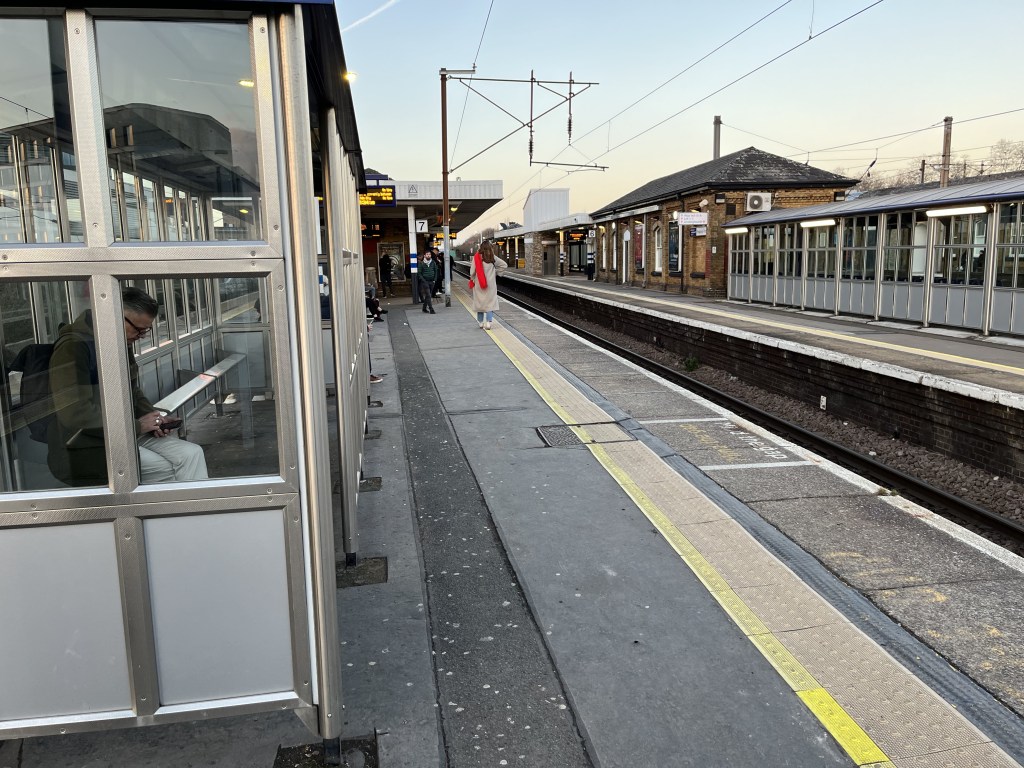
Running through this spot on the platform is a slightly darker piece of tarmac where a cable has been laid in the station surface. The darkness shows up the contrast with a thousand little white dots. It is festooned with trampled specks of discarded well-chewed gum, clustered at the entrance to the bus shelter style waiting booth just to the north. I have seen many people hunkered down in this little space like Emperor Penguins in anoraks of every colour. They lean against its angled cold metal seating bench, as the wind whistles its way up Seven Sisters Road from the southwest and, at this high point, chills the bones on a cold night to a freshness that would have been mirrored in the initial flavour of that same gum that litters the floor.
When standing with your back to this persistent wind, perhaps using the large “Welcome to Finsbury Park” running in board to provide a little eddy of stillness, it is interesting to look up and view the local roof tops ahead. At night, there can be a little glow from the scarlet and blue neon of the sign for the Rowan’s Bowling Alley emanating from the direction of the park. You can hear the buzz of the buses and traffic in the forecourt of the station. This is a busy interchange that is never quiet and is often punctuated by the blue flash and siren of emergency vehicles rushing up and down the Seven Sister’s Road. One of the roads at this junction is Rock Street, which quickly leads on to St Thomas’s Road. A key roof top you can see at the northern end of this street is the soft bronze dome of Finsbury Park Mosque.
This always leads me to think of the contradictions and integrations in modern day Britain that I see every time I walk down St Thomas’s Road on my way to the Emirates Stadium. In order, the things I see are the following: Firstly, there is the outside of the station itself. On matchday’s this is a busy meeting point full fans regaled in red and white and you may hear your first chant of the day. The police are often here in good numbers. There tends to be a palpable smell of tobacco, (and other!), smoke in the air, as those who have been on the train or tube for a while, catch up on a little “fresh air”. I turn right and cross the busy road at the lights, probably weaving in and out of some buses or other vehicles stuck in the junction as they underestimate the time taken to cross the interchange.
The first shop on the right is the bookies. This is always busy on matchdays with punters nipping in to have a flutter on the games of the day. I have never partaken in this myself, but I am always intrigued to have a guess at the day’s score. Most of the time I wouldn’t have won a thing! And then next on the road is the mosque. One of the things that always makes me proud to be an Arsenal fan is just how multicultural we are as a club and many a time, I have seen fans coming out of the mosque after prayers with their red and white scarves on ready to walk down to the stadium. I often wonder how they feel about the next noticeable thing on the left of the road. Almost opposite the entrance is the temporary burger van with its bacon cheeseburgers advertised in bold white letters! It has always felt a bit of an odd juxtaposition to me!
St Thomas’s Road itself is predominantly made up of Edwardian terraced three story homes. These have often been split into flats, but it is a reasonably well-off area, and some are still clearly full houses. They have ornate bay windows on the ground floors that in winter are lit up with a myriad of Christmas lights of all hues and flashing combinations ready to test out the retinas of any passers-by.
By this point, fans have normally spread out into the road and any vehicles that may be attempting to come the other way proceed at a snail’s pace. The regret of the drivers is clearly shown in their wide-eyed facial expressions as they ice break their way through the crowd. About a third of the way down is the Auld Triangle / Plimsoll pub. They will have portioned off a bit of the road for clients to stand outside and enjoy their pre-game drinks. This is a tiny pub that conjures up feelings of the classic London “battle cruiser” with its dark wood panelled walls, tang of old beer in the air and bar stools around well used tables. Always lively pre and post-game, it is one of the many Arsenal pubs in the area.
At the end of the road, again representing the variety of sights of modern London, can be found firstly, the entrance to the Gillespie Park Nature Reserve, then the red brick St Thomas’s Church itself and finally the last building on the road, the house owned by the Arsenal Supporters Club. Here you can by a pint and a bacon butty from the ad hoc serving hatch in the ground floor windows via the front yard.
Dead ahead at the junction here is a modern build three story home, integrated into the older terraces on Gillespie Road. This home represents where the old gates to the North Bank of Highbury Stadium were found and it filled in the gap when this entrance was no longer needed as the ground was redeveloped into housing in the mid-2000s. Often seen here are the older fans explaining to the younger ones, the history of Arsenal and their experiences of coming to Highbury and entering via those gates. I reminisce doing that myself. I bought a scarf on this spot in 1993 which has been with me to every Arsenal home game I have ever been to. It’s still in pretty good nick considering.
A right turn here takes us along Gillespie Road, pass yet more temporary eateries who have rented front yards to sell everything from pulled pork baguettes to German footlong hotdogs and Greek kebabs. The bustle increases at the bottom of Highbury Hill as the fans flood out of Arsenal tube station. (Originally called Gillespie Road by the way. It was changed in the 1930s after a campaign from legendary Arsenal manager Herbert Chapman).
This is a great people watching spot in of itself. You can see locals weaving to try to get home, rolling their eyes at the lurking fans taking photos of the roundel and first time fans checking satnavs to see where to go for the Emirates. In response to queries in all the accents of the world, you’ll probably catch some old hand saying, “down there, round to the left and its about 50 yards down on the right”.
You see young bright eyes catch sight of the burger vans and “merch” stalls on the road with their mix of signed photos, knitwear covered in club badges and less than authentic replica shirts. The smell of cooking onions overpowers everything else. Despite the police presence, you might catch the eye of a man saying “buy or sell tickets” as the touts work that part of the street. One of the weirdest things I have ever seen was on this corner. A ticket tout and a “Free Palestine” campaigner having an argument over the virtues of self-determination! It was very weird to listen to.
You can also hear the sound of the fella selling “The Gooner” and “Up The Arse” fanzines (for all your best Tottenham jokes)! There also might be a man standing there selling the now abundant tragedy that is the half and half scarf. I can cope if you are fan on a tour for a European game and maybe want to commemorate your visit, but who seriously buys a half Arsenal, half Spurs, Chelsea or Man Utd scarf? I mean come on!
As I mentioned, it is then a quick turn round the corner to get to the stadium. But the stadium can also be viewed from my little spot on platform 7. It sits on the far skyline, with only the glass obelisk skyscrapers of the City of London further back in the distance. Their little red aircraft warning lights punctuating the horizon. The crimson glow of “Emirates Stadium” on the North Bank stand shimmers of an evening and reflects on the clean surfaces of the regularly used rails and overhead wire of the catenary suspended from dark grey metal gantries. The only green, and sometimes pink-purple flowered contrast, is that of the overgrown buddleia plants that have invaded much of Britain’s railways. There is even a sprig that has manifested itself in a disused chimney at the end of the platform in between two of the spans of the railway bridges, giving the stack a slight appearance of a Roman Centurion in his elaborate helmet.
The Romans do crop up everywhere in England and this is no exception. I learned recently that the aforementioned Highbury Hill was once the location of a Roman garrison. Having been to Manchester and Chester this past week, both cities founded by the Romans and where you can still see and even walk the walls in Chester’s case, they can still feel very alive in day-to-day life as well. In fact, I live about 100 yards from the alignment of the Roman Road Ermine Street and despite moving north by about 25 miles, grew up about the same distance from that alignment. I still travel it at least once a week and at speeds the marching Legionnaires heading from Londinium to Eboracum or Fort Vindolanda would have only dreamed of.
There may even be a more subtle link to the Romans that takes me back to that spot on platform seven. And here we do get that bit geeky again! As I look at the steel rails and concrete sleepers of the railway track, I am reminded that those rails are exactly four feet, eight and a half inches apart. This is a very specific measurement and yet is used almost globally as a standard for railway track. If you take the half inch out of the equation for a minute and allow that the rails are two inches wide, this makes exactly five feet. Five feet has been used for centuries as the standard width for wagon wheels as it works well with the width of a single oxen or horse. It may in fact be the standard measurement that the Romans used, although this is unproven, but can be seen in the ruts in Roman roads. You can also see this on a very old piece of road near me just off Ermine Street and in many other places, where smooth stones have been laid to aid wheel rolling but in between are cobbles to aid the horse’s hooves to grip. Those smooth stones are four foot eight inches apart.

That means potentially that the Romans influenced the development of the standard wagon all the way to the industrial revolution, and therefore rail-based horse-drawn tramways, and eventually Robert Stephenson, (who added the half inch to aid transit of curves), creating the Stockton to Darlington railway. And so as I watch modern LNER Azumas accelerate up to 125 mph out of London at Finsbury Park, it is interesting to think that their design has in some way been influenced by the Romans.
But why that particular bit of platform seven? Well in the end, if I am catching a Cambridge train that has come up from St Pancras home from the football, (which are the quickest), the carriage that stops there will be directly opposite the exit stairs on platform 2 at my home station in Royston. Keeps the walk short! As for the contemplation. This is an inevitability of this service. Unfortunately, it often is rather offset by the time I get back from evening Arsenal games walking up St Thomas’s Road. I have had to stand there for 40 mins for my next train on some occasions, and my mind, like the Romans, wanders/wonders! Sure, most of the time I am thinking about the football, but still!
Does that make that location at 51.56415, -0.10668 remarkable? When you think of all the people that will have stood there, the thoughts they would have had, the things they will have seen including all the changes and developments that have occurred over time, and therefore the lives it has influenced, I think it does. I look forward to being back there in a couple of weeks. Hopefully thinking about a win!



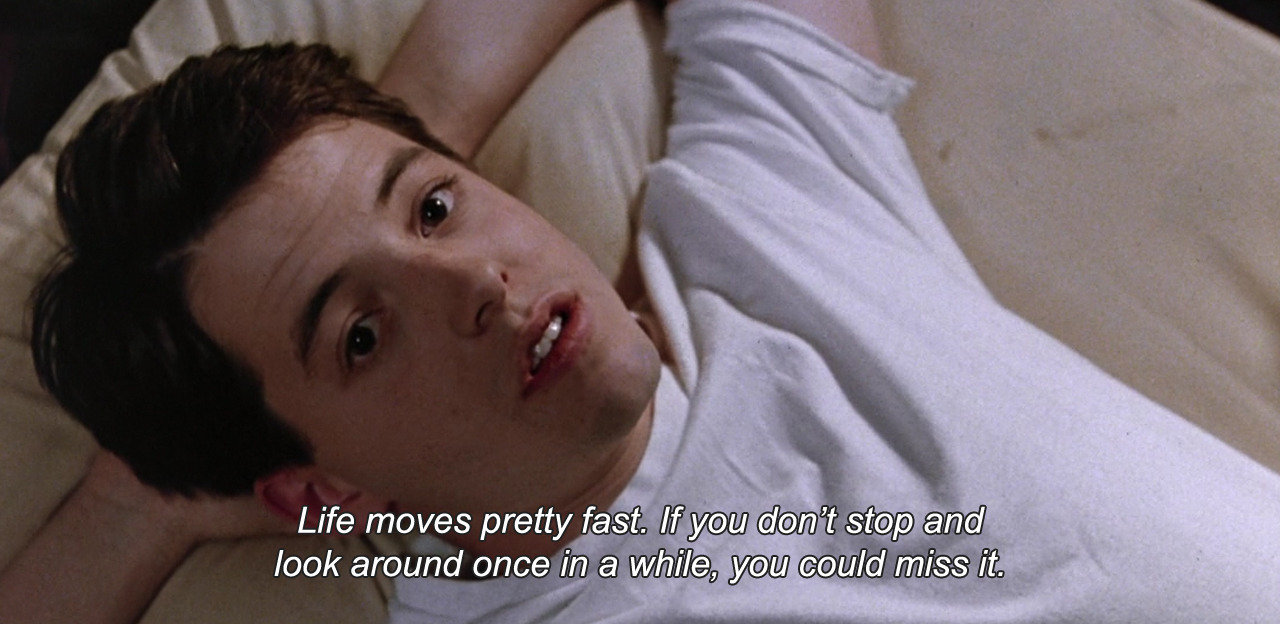
 Life moves pretty fast
Leave a comment